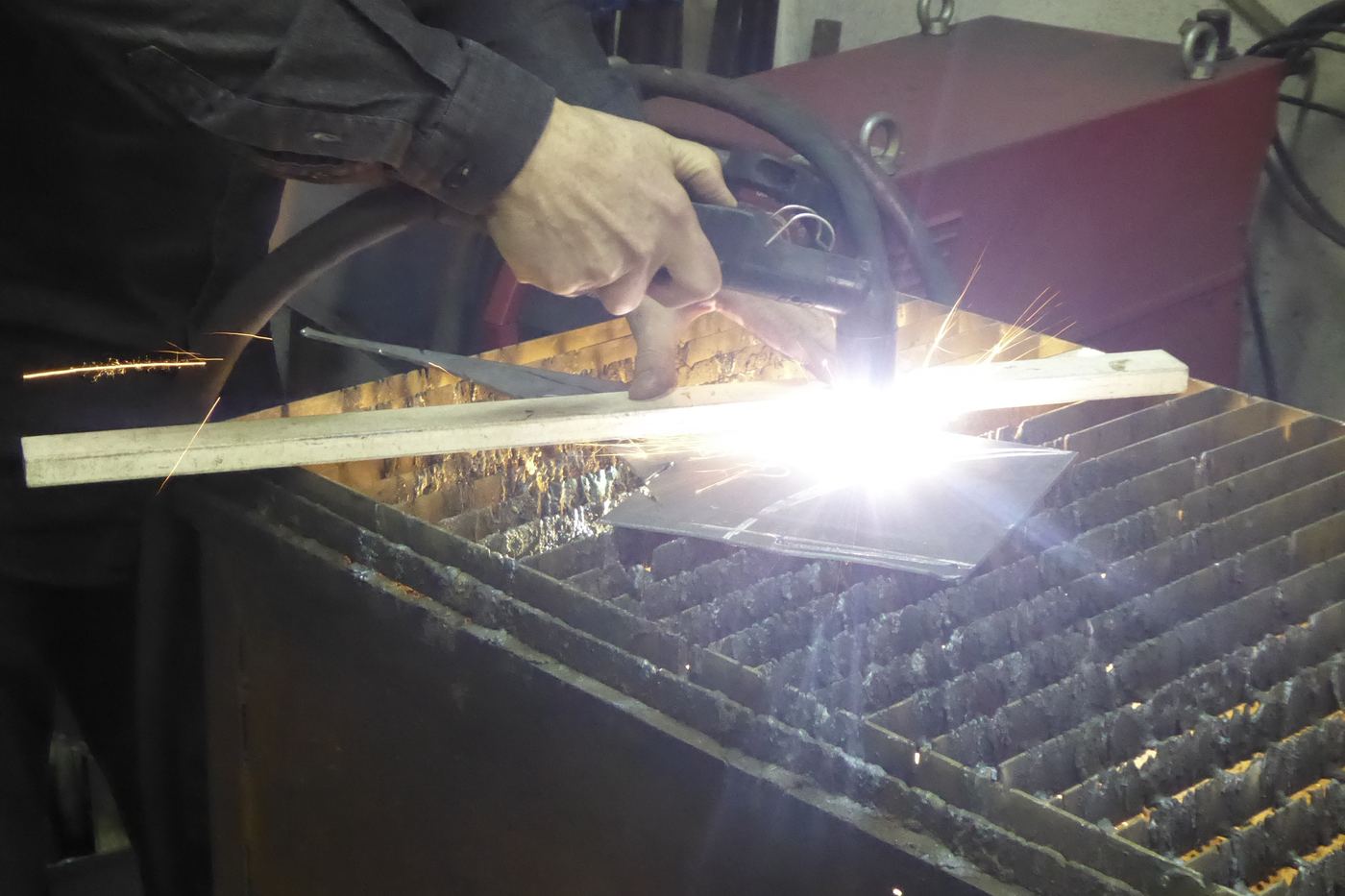
Plasma cutting is the fast, economical way to turn carbon steel plate into gussets, base plates, brackets and flanges. It cuts thick steel quickly and leaves an edge that's ready to weld. We source the plate and coordinate the cut through our supply network, then deliver the parts.
What plasma cutting does well
Plasma earns its place on carbon steel plate from about 3/16" up past 1-1/2". High-definition machines cut these thicknesses much faster than laser or waterjet, which keeps the cost per part down on structural work. Base plates, clip angles cut from plate, trailer gussets, skid parts and bolt-up flanges are all typical plasma jobs.
It also handles expanded metal and grating and aluminum diamond tread plate cut to shape, where a clean laser edge would be wasted money.
Tolerances and edge quality
Expect profile tolerance around ±1/32" to ±1/16" depending on thickness and the machine. The edge has a slight bevel, usually a few degrees, with one good side and one side that leans. There may be some dross on the bottom edge that knocks off with a chipping hammer or grinder. The heat-affected zone is wider than a laser cut.
For welded fabrication none of that matters much. The bevel can even help weld prep. For bolt holes that need to fit tight, see below.
Holes and small features
Plasma holes come out slightly tapered and are weakest when the hole diameter is close to the plate thickness. A common rule is to keep plasma-cut holes at least one and a half times the thickness. For bolt holes that need a real fit, have them cut undersize and drill or ream to finish, or move the part to laser cutting if the plate is thin enough.
Files we need
A DXF or DWG at 1:1 scale, units stated, closed contours, no duplicate lines. Mark which side is the good side if bevel direction matters. List grade, such as A36 or A572 Grade 50, thickness and quantity for each part.
When plasma is the wrong method
Thin sheet, detailed profiles and small holes are better on a laser. Aluminum and stainless can be plasma cut, but the edge is rough and needs cleanup, so waterjet cutting or laser usually makes more sense for visible parts. Very thick carbon plate, well beyond 2", is often cut with oxy-fuel, which is slower but handles the thickness cleanly. Parts that must keep their hardness at the edge should avoid plasma entirely.