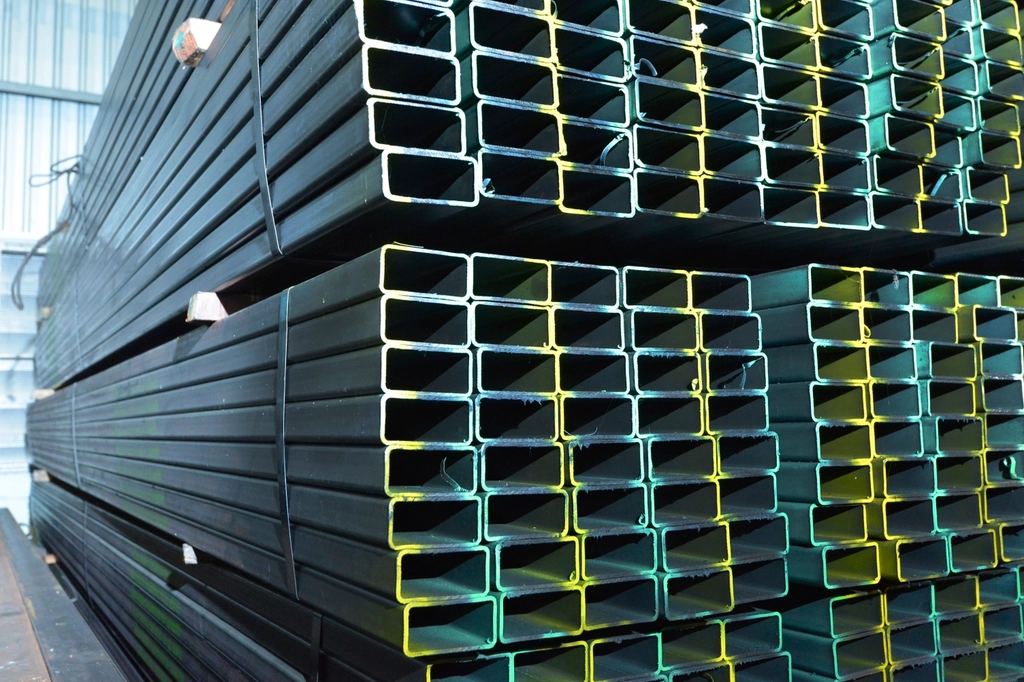
A36 is the standard structural carbon steel in the United States. Plate, flat bar, angle, channel and many other shapes are made to it, and it is the steel most fab shops weld every day. It is easy to cut, easy to weld and forgiving. We source A36 plate and structural shapes and arrange plasma, laser or saw cutting to your sizes.
What A36 steel is
A36 is an ASTM specification, not a chemistry in the way 1018 or 4140 is. ASTM A36 sets a minimum yield strength of 36 ksi and a tensile range of 58–80 ksi, with maximum limits on carbon (about 0.25–0.29% depending on thickness), phosphorus and sulfur. It is a low-carbon, hot-rolled steel.
It covers plate, bars and structural shapes. Thin sheet is a different product: hot-rolled sheet is usually sold to ASTM A1011 and cold-rolled to A1008, which behave much like A36 in the shop but are certified differently. If a drawing says A36 on 14-gauge material, it is worth a quick question.
A36 properties
| Property | Value | What it means in the shop |
|---|---|---|
| Tensile strength | 58–80 ksi | Specified range; any heat will fall in it |
| Yield strength | 36 ksi minimum | 32 ksi minimum on plate over 8 in thick |
| Hardness | About 120–160 Brinell typical | Not specified by A36; soft enough to drill and tap easily |
| Density | 0.284 lb/in³ (7.85 g/cm³) | A 1 in plate weighs about 40.8 lb per square foot |
| Weldability | Excellent | Any common process and E70 filler |
| Machinability | Fair | Mill scale and hot-rolled surface; cuts fine once through it |
| Corrosion resistance | Low | Rusts; paint, powder coat or galvanize it |
Tensile and yield per ASTM A36. Hardness is typical, not a requirement.
Typical uses
- Base plates, gussets, brackets and mounting plates
- Trailer frames, truck beds and equipment skids
- Ag and ranch equipment, gates and feeders
- Building structures, stairs, platforms and mezzanines
- Oilfield skids, pipe racks and general structural fabrication
Common conditions
A36 plate and shapes are hot rolled with mill scale, the blue-gray skin that has to come off before painting or a good weld on critical joints. Pickled and oiled (P&O) material has the scale removed with acid, which is cleaner for laser cutting and painting; it is more common on lighter plate and sheet. Shot blasted and primed plate is also available for structural work that will be painted.
Plate is usually cut from larger mill plate, so edges can be sheared, plasma, laser or saw cut. Use the metal weight calculator to check weights for freight and lifting before you order.
A36 vs A572 Grade 50
ASTM A572 Grade 50 is a high-strength low-alloy steel with a 50 ksi minimum yield and 65 ksi minimum tensile. It lets an engineer use a thinner or lighter member where strength controls the design. Wide-flange beams are now commonly rolled to A992, and a lot of plate, angle and channel is dual certified A36/A572-50, meeting both.
Both steels have the same stiffness. If a part is sized to limit deflection, going to Grade 50 saves nothing. A572-50 also welds well, though thick sections may want more preheat. If the drawing specifies A572-50, do not substitute A36.
| A36 | A572 Grade 50 | |
|---|---|---|
| Minimum yield | 36 ksi | 50 ksi |
| Tensile | 58–80 ksi | 65 ksi minimum |
| Alloying | Plain carbon | Carbon plus small amounts of niobium or vanadium |
| Stiffness | Same | Same |
| Typical use | General fab, plates, brackets | Structures designed on strength |
Welding and machining A36
A36 welds with any common process: MIG with ER70S-6, flux core with E71T, or stick with E7018 or E6010. Grind off mill scale where the joint matters. Thin material needs no preheat; heavy plate does, and AWS D1.1 sets minimum preheat that rises with thickness above about 3/4 in. Keep low-hydrogen rod dry.
A36 drills, taps and mills without trouble once you are under the scale. Because its chemistry varies within the spec, it does not machine as consistently as cold-finished 1018. For precise machined parts, cold finish bar is the better starting point.