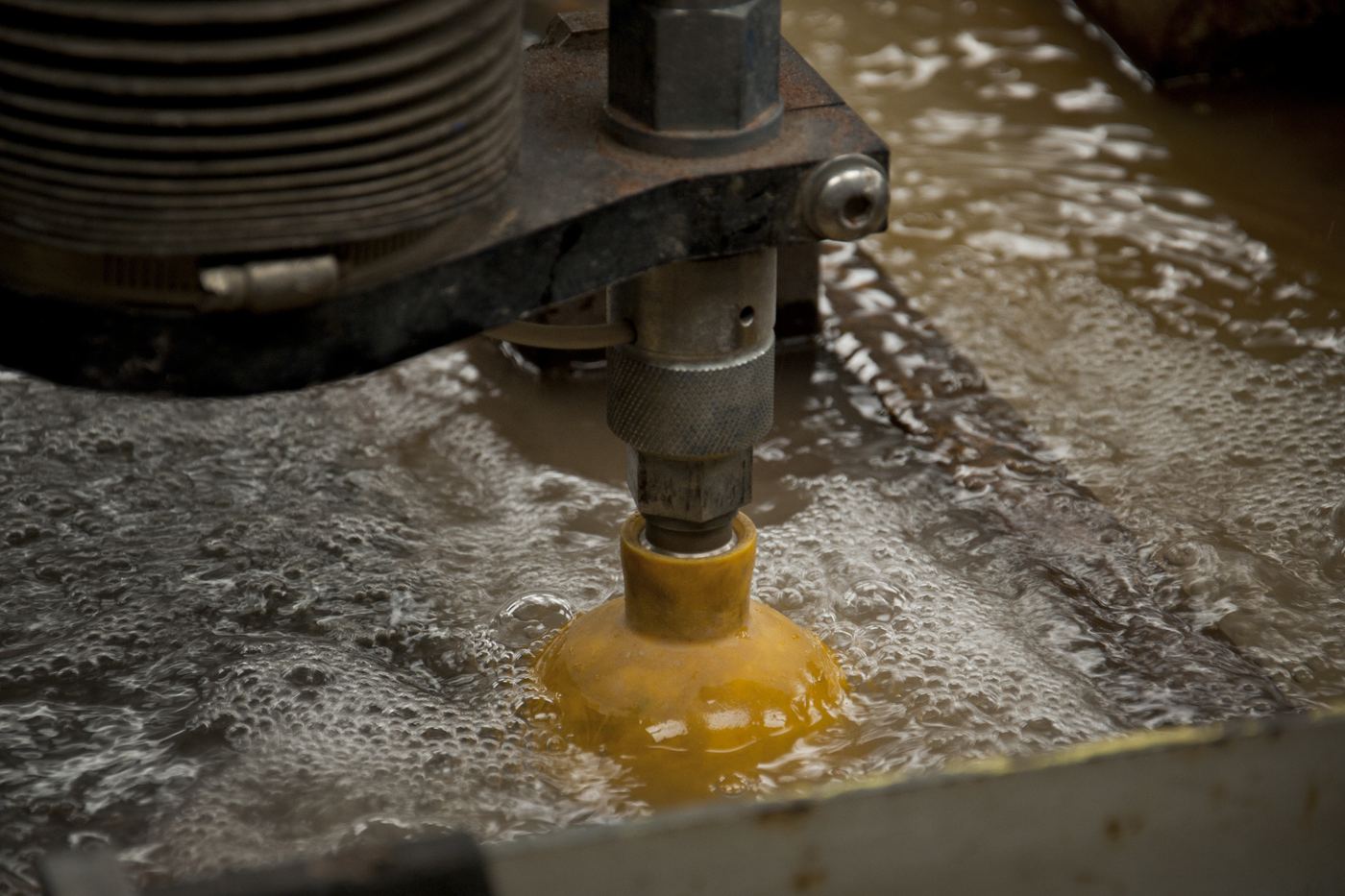
Waterjet cuts with a high-pressure stream of water and abrasive, so it puts no heat into the part. That makes it the method for thick aluminum, copper, brass, hardened material and any part where the edge must keep its original properties. We source the material and coordinate the cut through our supply network.
What waterjet does well
Waterjet cuts almost any metal at almost any practical thickness. It handles aluminum plate several inches thick, copper sheet and bus bar, brass, titanium, and stainless plate without the reflectivity or heat problems lasers and plasma run into.
Because there is no heat-affected zone, there is no hardened edge to break drills on and no temper loss. That matters on 7075 aluminum and 6061-T651 plate, pre-hardened steels and tool steel, where heat at the edge would change the material you paid for.
Tolerances and edge quality
Typical profile tolerance is around ±0.005" to ±0.010" on moderate thicknesses. The edge has a satin, sand-blasted texture with no burr and no dross. On thick parts the stream lags and spreads, leaving a slight taper and faint striations toward the bottom edge. Machines with taper compensation reduce that, and slowing the cut improves the finish at a higher cost.
For machined parts, waterjet near-net blanks save a lot of roughing. Cut the profile with a little stock left on critical faces and finish them on the mill.
Materials and thickness
Waterjet works from thin sheet to plate well over 4" thick in aluminum, and several inches in steel. Cutting speed falls as thickness rises and harder alloys cut slower, so thick steel parts cost more on waterjet than on plasma. Thin sheet can flutter under the jet, so very thin gauges are often better on laser.
Stacking helps on thin material. Several sheets clamped together can be cut in one pass, which brings the cost per part down on short runs of copper or brass blanks. Tell us the total quantity and we'll note whether stacking applies.
Files and when to choose something else
Send a DXF or DWG at 1:1 scale, units stated, closed contours, one part per file or clearly separated. Note which faces are critical so the lead-in and lead-out points go somewhere harmless.
For production runs in thin steel or stainless, laser cutting is faster and costs less. For thick carbon steel where a heat-affected edge is fine, plasma cutting wins on speed. Straight cuts on plate usually cost less on a saw.