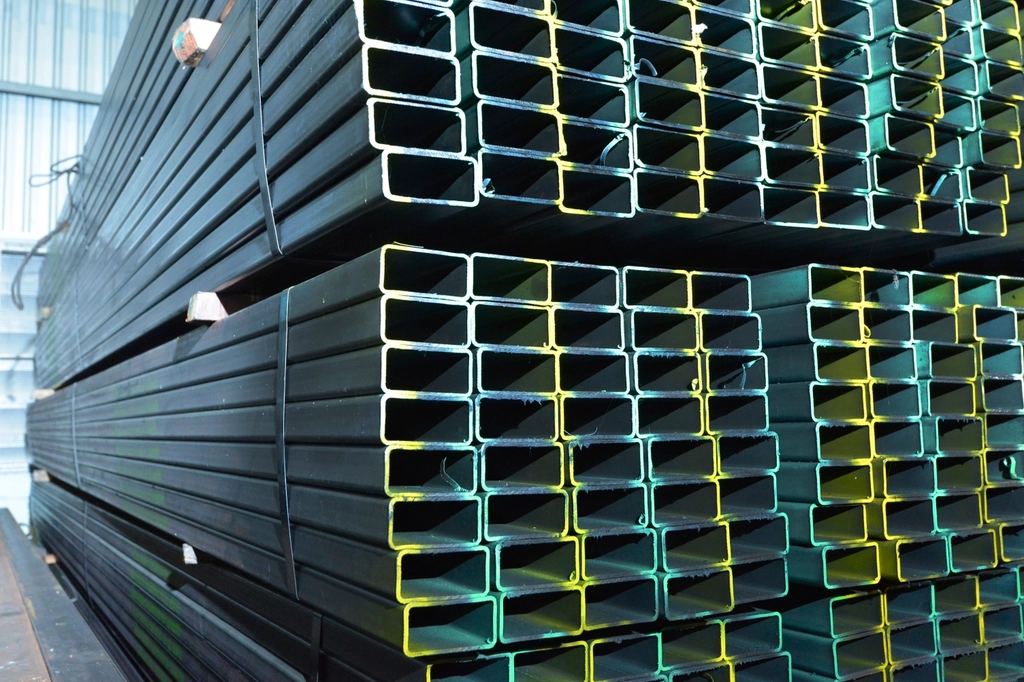
Square and rectangular tube frames most of what small Texas shops build: trailers, gates, headache racks, feeders, carts, handrails and equipment bases. We source A500 structural tube and A513 mechanical tube in the common sizes and walls, arrange the cuts and miters, and deliver the pieces ready to fit.
What it's used for and how to choose
Tube resists twisting far better than angle or channel of the same weight, and a closed section looks finished without extra work. That's why it frames trailers, truck beds, gates and furniture. Rectangular tube puts more stiffness in one direction; stand it tall in the direction the load pushes.
The first real choice is the spec. A500 is structural tube: it carries a guaranteed minimum yield, which is what an engineer or a load-rated design needs. A513 is mechanical tube: tighter size and wall tolerances and a smoother surface, used for parts that slide, telescope or get machined, but it is not ordered for its structural strength. A trailer frame should be A500. A telescoping jack sleeve or a sliding hitch receiver may be better in A513.
Wall thickness is the second choice. 14 gauge and 11 gauge cover most light frames and gates. 3/16" and 1/4" walls take the load on trailer mainframes, tongues and equipment skids. Heavier wall also welds more forgivingly for a shop running MIG on thick sections.
Grades
| Grade / spec | Why pick it | Watch out for |
|---|---|---|
| A500 Grade B | Structural tube with a guaranteed minimum yield. Long the default for fab work. | Much of what the market sells today is dual-certified B/C. Ask for the cert if it matters. |
| A500 Grade C | Higher minimum yield than Grade B, so it's what engineers typically specify now. | A500 allows wall to run under nominal, and designers account for it. Don't assume a full 1/4" wall when checking capacity. |
| A513 (Type 1 or 2) | Mechanical tube with tight tolerances and a clean surface. Good for sliding fits and machined parts. | No structural yield guarantee to design against. Not a substitute for A500 on load-rated work. |
Common sizes
| Type | Commonly available range | Common walls |
|---|---|---|
| Square tube (A500) | 1/2" to 8" and larger; 1", 1-1/2", 2", 3" and 4" are everyday sizes | 16 ga (0.065"), 14 ga (0.083"), 11 ga (0.120"), 3/16", 1/4", 5/16", 3/8", 1/2" |
| Rectangular tube (A500) | 2" x 1" up to 8" x 4" and larger; 3" x 2", 4" x 2" and 6" x 2" are common trailer sizes | 14 ga, 11 ga, 3/16", 1/4", 5/16", 3/8" |
| Mechanical tube (A513) | Small square and rectangular sizes, 1/2" up to about 4" | Light gauges, 18 ga through 11 ga |
Typical mill lengths are 20', 24' and 40', depending on size. Sizes only. Metal prices move daily, so every order is quoted.
Cut-to-size options
Straight saw cuts to length are the common order, and we can arrange 45° and other miter cuts so a frame goes together square. For tube meeting tube at an angle, coping or notching can be arranged on request. Tell us the angle and which face it's cut on.
Cut pieces come off full lengths, so a cut list that nests well into 20' or 24' sticks wastes less. Send the whole list and we'll quote it as a set.
What to include in your quote request
- Outside size and wall, e.g. "2 x 2 x 11 ga" or "4 x 2 x 3/16"
- Spec: A500 (and Grade B or C if required) or A513
- Cut lengths, quantities and any miters with angles
- Full sticks or cut pieces, and your preferred stick length if you're buying full lengths
- Mill certs if your customer or inspector needs them
- Delivery location